


4 Elements Artificer Subclass Guide: Elemental Golems, Resistances, and Frontline Power in D&D 5e
- Jan 7
- 6 min read

In a fantasy world where bending the elements defines legends, the 4 Elements Artificer feels like the natural meeting point between Avatar: The Last Airbender, Fullmetal Alchemist’s alchemy-driven combat, and the golem-crafting traditions seen in The Elder Scrolls and The Witcher. Like Iron Man channeling science into raw elemental force or a Pokémon trainer commanding typed creatures with strengths and weaknesses, this subclass captures the fantasy of commanding elemental power through intellect rather than innate magic. For players drawn to cinematic control over fire, water, earth, and air, the 4 Elements Artificer offers a compelling and visually striking archetype firmly rooted in tactical D&D 5e gameplay.
Mechanically, the 4 Elements Artificer allows an artificer to control elemental golems that define both offense and defense. The subclass grants heavy armor proficiency, Intelligence-based weapon attacks, elemental damage scaling, and shared resistances that tie the artificer directly to their golem’s element. Unlike traditional spell-focused artificers, this subclass leans into weapon combat supported by elemental damage dice and resistances, creating a hybrid role that functions as both a tank and a damage dealer. The elemental golem serves as the subclass’s core mechanic, dictating damage types, resistances, and tactical flexibility.
This subclass will appeal most to players who enjoy planning ahead, managing damage types, and adapting to enemy resistances. Because each elemental golem deals only a specific damage type, players must anticipate encounters and understand monster vulnerabilities. Players who enjoy Battle Smith–style companions but want more elemental flavor and higher personal durability will find this subclass especially rewarding. It is less forgiving for improvisational players and best suited for those who enjoy calculated, strategic combat.
Dungeon Masters allowing this subclass should expect a durable frontline artificer with strong elemental resistances and reliable damage output. Encounters that rely too heavily on a single elemental damage type may unintentionally empower the subclass. DMs should also be aware that the elemental golem’s movement traits allow it to bypass many physical obstacles, meaning traditional barriers, doors, and terrain restrictions may not limit the subclass as expected. Thoughtful encounter variety and mixed damage sources are key to maintaining balance.
4 Elements Artificer — Subclass Description
Every scientist wants to control the elements, but the 4 Elements Artificer goes further by giving them artificial life. Through advanced experimentation and magical engineering, this artificer animates elemental forces into obedient golems. These elemental constructs inspire fear in monsters and mortals alike, acting as extensions of the artificer’s will. Beginning with a single elemental form—Earth, Fire, Air, or Water—the artificer’s mastery grows over time, eventually allowing the fusion of compatible elements into more advanced golems.
Mechanically, the 4 Elements Artificer is defined by its elemental golem companion and elemental damage identity. The subclass emphasizes weapon combat enhanced by elemental damage dice, resistance sharing, and limited access to high-level elemental spells. Rather than relying on spell slots for damage, the artificer leverages Intelligence-based weapon attacks and persistent elemental bonuses, filling a sustained combat role similar to a martial defender with magical augmentation.
Level 3 Features:
Battle Ready:
Your combat training and your experiments with magic have paid off in two ways:
You gain proficiency with martial weapons and Heavy Armor.When you attack with a magic weapon, you can use your Intelligence modifier, instead of Strength or Dexterity modifier, for the attack and damage rolls.
4 Elements Spells:
Your link to the elements allows you to learn spells from the wizard's class. When your Spellcasting feature lets you learn or replace a 4 elements cantrip or an 4 elements spell of 1st level or higher, you can choose the new spell from the wizard's spell list or the 4 element's spell list. You must otherwise obey all the restrictions for selecting the spell, which becomes an 4 elements spell.
Elemental Golem:
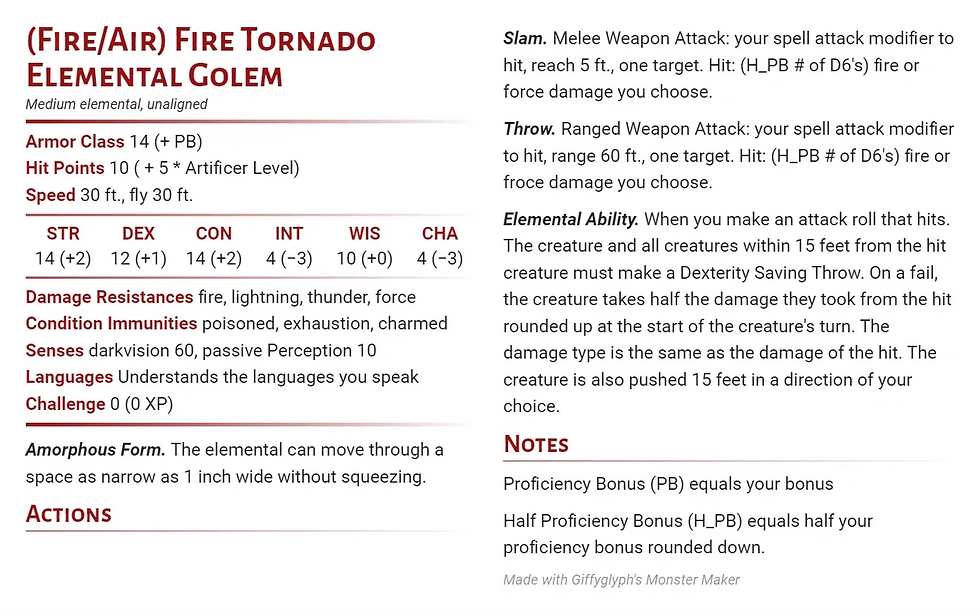
At 3rd level, you can control the elements giving them artificial life and a mind of their own. After a long rest, you can summon a medium size elemental golem of either Earth, Fire, Air, or Water that lasts for 24 hours. The elemental golem ability score and traits are presented in the Basic Elemental Table.
You can swap out the element of the golem after you take a short rest. The golem has a number of Hit Dice [d8s] equal to your artificer level. As an action, you can summon the golem and choose a different element if you expend a 1st-level spell or higher.
As a bonus action, you can command your elemental golem. If you do not designate a command to the golem, it will take the dodge action. If you are under the unconscious condition, the golem will try and take action to protect you.
Reasoning:
At 3rd level, the subclass establishes its hybrid identity. Battle Ready enables frontline combat through heavy armor and Intelligence-based attacks, while 4 Elements Spells dramatically expands spell versatility. The Elemental Golem functions as the subclass’s defining mechanic, offering elemental flexibility, resistances, and scalable damage that grows with artificer level.
Level 5 Features:
Shared Resistance:
At 5th level, you bond with the elements, and your golem gives you shared resistance. When you summon a golem, you gain resistance to the damage type of the summoned golem. The resistances change when you summon a different elemental golem.
When you take damage that is reduced by the shared resistance feature, you can use the resisted damage to either heal your golem or another creature within 60 feet of you. You can use this healing ability equal to half your proficiency rounded down.
Reasoning:
This feature reinforces survivability and party support at a tier where elemental damage becomes common. Shared resistance encourages tactical element selection while the healing conversion rewards intelligent positioning and damage mitigation.
Level 9 Features:
Elemental Infused Weapons:
Your golem's magic and yours intertwine at the 9th level, giving you more damage with magical weapons. When you make an attack roll with a weapon, and you hit then roll your golems dice, add the damage however, the damage is the same as your golems damage type.
Reasoning:
Because artificers are half-casters with limited spell slots and only one attack per turn, this feature compensates by significantly increasing weapon damage. It keeps the subclass competitive with other martial damage dealers without relying on spellcasting.
Level 15 Features:
Elemental Casting:
You can call forth You can cast Investiture of Flame, Investiture of Stone, Investiture of Ice, and Investiture of Wind as a 6th-level spell. You can use this ability only once, and the feature resets after a long rest.
Combined Elements:
You can combine elements; however, you cannot combine ones that clash, such as (Water/Fire and Earth/Wind). Look at the combined elementals table to select the one you want. All elementals damage dice increase to a D12.
Reasoning:
Elemental Casting provides late-game spell relevance through powerful thematic spells, while Combined Elements resolves elemental damage limitations by allowing alternative damage types and higher dice scaling, ensuring effectiveness against resistant or immune enemies.
4 Elements Artificer in Campaign Setting
Build Ideas
The best ability scores for this subclass prioritize Intelligence first, as it governs weapon attacks and spellcasting. Constitution follows closely due to concentration requirements and frontline durability. Strength is important only if the player intends to wear heavy armor, making it a situational but relevant choice.
The best feats for this subclass include Resilience (Constitution), as suggested in the source material. This improves concentration reliability and overall survivability, particularly when maintaining elemental casting effects in prolonged combat.
The best multiclass options for this subclass include Warlock. Taking two levels of Warlock grants short-rest spell slots that can be expended to resummon the elemental golem, along with access to Eldritch Invocations and Pact features that synergize with sustained combat play.
How to Play the Subclass
Social Interactions:
Subclass does not help with social interactions
Combat Encounters:
The subclass excels in combat, particularly against enemies that deal elemental damage. It struggles more against creatures that rely on radiant or necrotic damage, such as undead and celestials.
Exploration Interactions:
Elemental golems provide flight, burrowing, or swimming depending on element selection. Shared resistance improves survival in hazardous environments like volcanoes or extreme climates.
Environmental Interactions:
The subclass performs well in environmental interaction due to golem traits like Amorphous Form and Earth Glide, allowing movement through terrain, walls, and under doors, bypassing many physical obstacles.
Basic Golem Stat Blocks


Combined Golem Stat Blocks






Comments