


Circle of the Spirit Druid 5e: A Spectral Wild Shape Subclass Guide
- Feb 24
- 5 min read
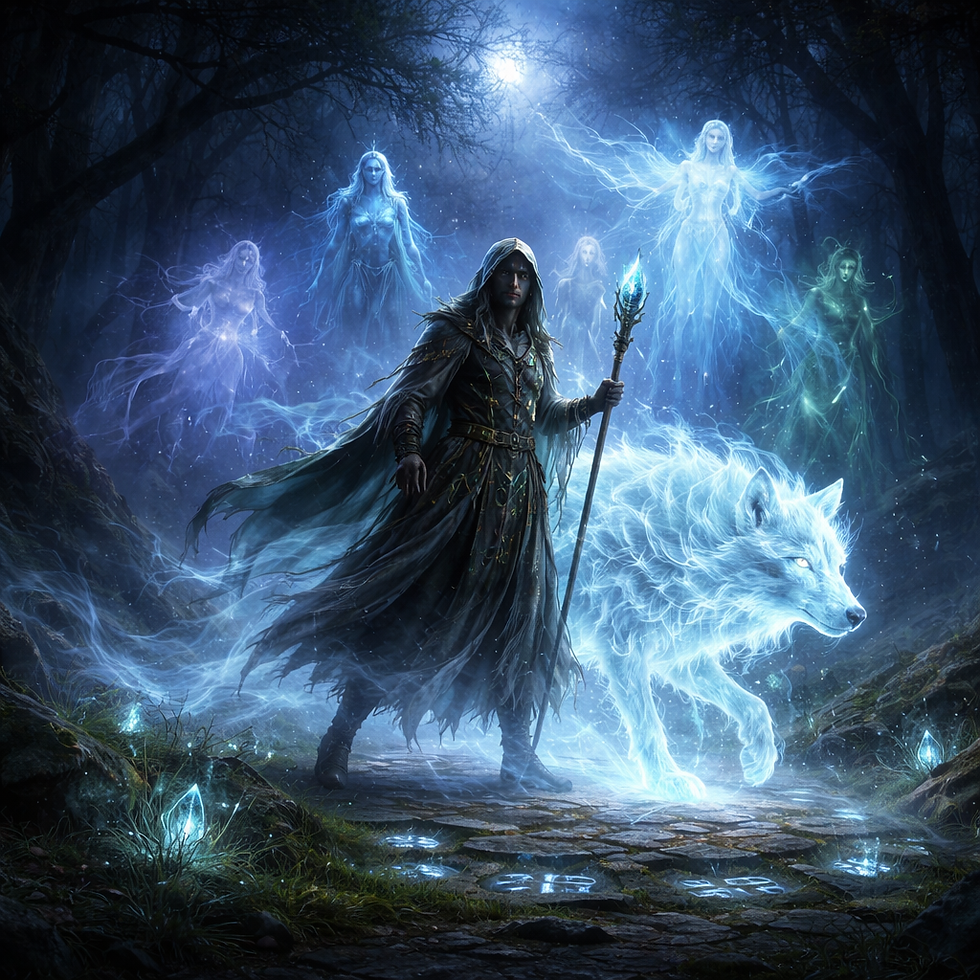
Like a druid stepping straight out of Princess Mononoke, a spirit medium from Avatar: The Last Airbender, or a spectral summoner reminiscent of Bleach or The Lord of the Rings’ Army of the Dead, the Circle of the Spirit druid walks the liminal boundary between life and afterlife. This subclass reimagines Wild Shape not as a purely bestial metamorphosis, but as an ethereal evolution—one inspired by the summoning magic of Tasha’s Cauldron of Everything. Rather than transforming into apex predators like a tyrannosaurus or elemental juggernaut, the Circle of the Spirit druid channels summoned entities, spectral forces, and lingering souls, becoming a conduit between worlds.
Mechanically, the Circle of the Spirit expands Wild Shape to allow transformation into summonable creatures tied to specific summoning spells. These forms scale with proficiency bonus, limiting access in early tiers while opening greater versatility at higher levels. The subclass also enhances magical strikes, allows communication with the dead, enables hybridized spirit forms, and culminates in the ability to bind fallen creatures as spectral servants. Its power ceiling is intentionally moderated compared to the Circle of the Moon, favoring versatility and utility over raw durability.
This subclass is ideal for players who enjoy adaptability, thematic flavor, and tactical flexibility. Those who prefer commanding spirits, gathering forbidden knowledge, and reshaping their combat identity mid-encounter will find this druid compelling. Rather than overwhelming enemies with brute force alone, the Circle of the Spirit rewards creative positioning, resistance selection, and information gathering.
Dungeon Masters allowing the Circle of the Spirit should expect high versatility but controlled scaling. The subclass uses summon spell frameworks to avoid access to problematic monster stat blocks. Its durability remains below that of high-end Moon Druids, and its spirit-binding feature offers narrative opportunities without exceeding expected power boundaries. Thoughtful monster variety in encounters is encouraged to engage the subclass’s resistance and damage interactions.
Circle of the Spirit — Subclass Description
Druids of the Circle of the Spirit form profound bonds not only with nature, but with the unseen forces that linger beyond mortal perception. These druids commune with spirits of beasts, fey, undead, and other entities that dwell between planes. Their magic reflects an attunement to both primal life force and lingering souls. Through ritual and reverence, they cultivate an otherworldly rapport that allows them to take on spectral forms and draw insight from departed beings.
Mechanically, the Circle of the Spirit redefines Wild Shape by allowing transformation into creatures aligned with summoning spells. These transformations scale with proficiency bonus, restricting early access while expanding options at higher levels. The subclass emphasizes magical attacks, condition resistances, spirit communication, and battlefield adaptation. Its role balances frontline durability with investigative utility and summoner-style control.
Level 3 Features:
Circle Forms:
At 3rd level, you can assume the form of a spirit creature drawn from summoning magic.
Form Options
Choose a creature that can be summoned by a conjuration or summoning spell.
The spell must be of a level equal to or lower than the highest-level spell slot you can cast.
You turn into the creature and is treated as if it were summoned using your highest-level spell slot.
Temporary Hit Points
Instead of gaining the creature’s hit points, you gain temporary hit points equal to the hit points it would have if summoned at that spell level.When these temporary hit points are reduced to 0, the transformation ends.
Summon Spells:
Command, Animal friendship
Summon beast, Animal Messenger
Summon fey, Summon undead
Summon aberration, Summon construct
Summon dragon, Summon celestial
Reasoning:
This feature provides an alternative to the Circle of the Moon’s broad creature access by tying transformation options to existing summoning spell frameworks. Scaling via proficiency bonus prevents early access to high-tier forms while allowing broad transformation flexibility at higher levels. Removing conditional traits, resistances, and immunities maintains balance.
Level 6 Features:
Magical Hits:
Upon reaching the 6th level, your magical prowess extends to your spirit form transformation.
you have the ability to include your charisma modifier to the damage roll of your attacks.
Furthermore, the capacity to cast spells remains available to you even during the state of wild shape.
Reasoning:
Spirit forms should deal magical damage comparable to Circle of the Moon scaling. However not as powerful. The circle of the moon can turn into a CR 6 monster at 18th level. We want similar however not as powerful ours go up to comparative to a 5th level spell.
Level 10 Features:
True Monstrosity:
At the 10th level, spirits manifest in diverse forms and dimensions, yet you possess the ability to blend and reshape them according to your requirements.
As you transform through summoning spells, you now have the option to select not one, but two classifications of monsters.
This choice grants you additional resistances and immunities to various conditions and damages.
Reasoning:
This feature enhances adaptability by allowing hybrid spirit forms. Access to combined classifications improves combat flexibility and survivability at higher tiers, while retaining spellcasting increases versatility. Which is more common in campaigns where the players are this level. Such as exploring under water castles or trying to dodge lava.
Level 14 Features:
Spirit Ascendance:
Your bond with the spirit realm deepens, placing you in a state between their world and yours while in your Spirit Form.
While in Spirit Form, you can assume a spirit form as if it were summoned by a 6th-level spell, regardless of your current spell slot level.
In addition, you learn the Summon Fiend spell. It counts as a warlock spell for you and does not count against your number of spells known.
Reasoning:
At this level of play, the campaign is likely nearing its conclusion or building toward a final boss encounter around level 20. However, warlocks are normally limited to 5th-level spell slots through Pact Magic.
Allowing this feature to function as a 6th-level summoning bridges that gap in a way that feels epic without granting full 6th-level spellcasting progression.
For example, if the warlock uses a summoning spell like Summon Beast, casting it at 6th level allows the spirit to make three attacks—mirroring the scaling impact of Eldritch Blast. This keeps their transformation competitive with their primary damage option while also granting significantly increased temporary hit points.
At this tier of play, the party is likely facing angels, fiends, and other high-CR creatures. Giving the warlock access to stronger spirit forms provides the durability and damage output necessary to stand alongside other late-game characters.
It also expands their tactical diversity, allowing them to assume forms better suited to different high-level threats rather than relying on a narrow set of options.
Circle of the Spirit in Campaign Setting
Build Ideas
The best ability scores for this subclass emphasize Wisdom as the primary attribute, as it governs spellcasting effectiveness. Constitution follows closely to support concentration and survivability. Other ability scores are secondary due to the subclass’s reliance on Wild Shape transformations.
The best feats for this subclass include War Caster for concentration support and Resilient (Constitution) for increased durability. Telepathy or telekinesis-oriented feats may enhance thematic expression depending on campaign tone.
The best multiclass options for this subclass include monk, cleric, and ranger. Cleric stands out due to strong early features, Channel Divinity access, and expanded spell versatility.
How to Play the Subclass
Social Interactions:
While this subclass isn't particularly adept at social interactions, it does provide the ability to acquire information using the "speak to the dead" spell, which can be cast whenever you wish.
Combat Encounters:
This subclass excels in combat. With increased effective durability through spirit forms and magical attacks, you are often positioned as a frontline combatant. Hybrid forms at higher levels allow flexible engagement styles.
Exploration Interactions:
The subclass enables stealthy approaches and information gathering through communication with deceased creatures, making it effective in reconnaissance and infiltration scenarios.
Environmental Interactions:
The subclass grants resistances based on chosen spirit forms, allowing traversal of hazardous environments such as volcanoes or graveyards. However, enemies may also resist or be immune to damage types aligned with your chosen form.


Comments