


Cloak of Gluttony: A Cursed D&D Artifact of Transformation, Hunger, and Monstrous Power
- Dec 12, 2025
- 5 min read
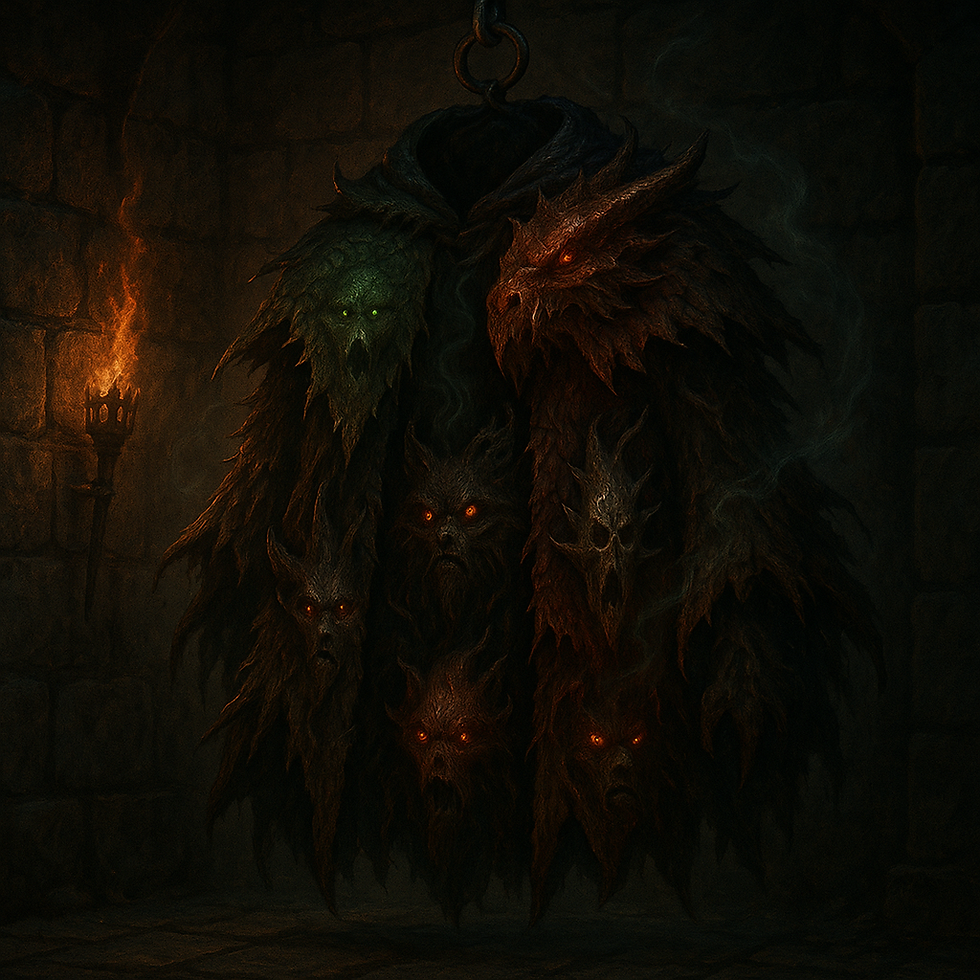
Like something torn from Hellraiser, stitched together with the grim trophy-hunting of The Witcher and the corrupting allure of artifacts straight out of The Lord of the Rings, the Cloak of Gluttony embodies temptation wrapped in power. In the realm of Dungeons & Dragons, this malevolent relic promises transformation, strength, and spectacle—while quietly demanding a terrible price. It is the kind of item that feels legendary the moment it enters a campaign, drawing players in with the same mix of fascination and dread that surrounds cursed artifacts across fantasy and pop culture.
Cloak of Gluttony – A Patchwork of Power and Temptation
In the realm of Dungeons and Dragons, behold the malevolent artifact known as the Cloak of Gluttony. Forged through dark rituals and wicked sorcery, this cursed item is fashioned from the flesh of mythical creatures and vanquished demons, their spirits forever bound within the fabric of the cloak. Each patch represents a different magical beast or celestial being, sacrificed in the pursuit of sport and power.
Once donned, the unsuspecting wearer’s mind becomes a cacophony of haunting sounds. The whispers and cries of the imprisoned spirits echo constantly, tormenting the soul and clouding judgment. Over time, an unholy hunger takes root in the wearer’s heart, compelling them to seek out more creature hides to expand the cursed garment.
Despite the malevolence that permeates the cloak, it grants the bearer an eerie and powerful ability: the capacity to transform into the creatures whose remains are sewn into its fabric. Each transformation grants access to the traits and abilities of those beings, offering incredible versatility. However, every use tightens the cloak’s grip, deepening the wearer’s bondage to its insatiable desires and drawing their soul further into darkness.
Adventurers must exercise extreme caution when encountering the Cloak of Gluttony. Its allure is cunning, its hunger ceaseless, and many have succumbed to its promises, becoming slaves to its malefic will. Only the most resolute and morally steadfast heroes may hope to resist its call and break the curse. Should they succeed, the cloak’s corrupted power could be turned against those who would exploit its dark magic for nefarious ends.
Cloak of Gluttony (Cursed Artifact Item)
The Cursed Cloak of Gluttony is a malevolent artifact imbued with dark power, allowing its wearer to transform into any creature the cloak has consumed since its creation. The cloak holds a single charge, which fully replenishes each morning. By expending this charge, the wearer may assume the form of creatures ranging from feeble, squirrel-like monsters to the mightiest of fiends and dragons.
Curse
The hunger of the cloak afflicts not only the wearer, but the entire party. All members are plagued by a constant, gnawing need and never feel fully satisfied. The party consumes double the normal rations each day.
Alternatively, half of the party must succeed on a Survival check to forage for anything remotely edible, no matter how foul or unappetizing. If they fail, all party members gain one level of exhaustion.
Ability
Activation: Free Action
Charges: 1DC: 13 + Proficiency Bonus
Usage: Once per long rest, expend one charge and roll a d100.
Effect Table
Natural Mutation (1–50)
Mechanics: Gain a Beast or Plant mutation until the end of the turn.
Speed increases by 5 × ½ PB feet
Beast: Bonus Action — make an unarmed strike dealing d6 × ½ PB piercing damage
Plant: Melee attackers take d6 × ½ PB piercing damage
Visual: Your form distorts with animalistic features or erupts with thorny vines.
Eldritch Frame (51–80)
Mechanics: Gain a Fey or Construct trait until the start of the next turn.
Bonus Action: Teleport 5 × PB feet
Fey: Add PB to all saving throws
Construct: Gain +PB to AC
Visual: Your body shifts into an otherworldly silhouette as space subtly warps around you.
Spirit Bloom (81–95)
Mechanics: Gain a Celestial or Undead trait until the start of the next turn.
Celestial: Allies within 30 feet regain d6 × 2 × PB hit points
Undead: Enemies within 30 feet take d6 × 2 × PB necrotic damage
Visual: Your core radiates either brilliant light or seething necrotic energy, pulsing outward.
Dracofiend Surge (96–100)
Mechanics: Gain a Dragon or Fiend form until the start of the next turn.
Dragon: Breath weapon (Dexterity save, 30-ft cone or 60-ft line, d6 × 3 × PB elemental damage)
Fiend: Burst aura (Wisdom save, 20-ft radius, d6 × 3 × PB fire damage; stunned for 1 round)
Visual: Your body momentarily warps into a colossal draconic or infernal silhouette.
Thought Process
I’ve always been fascinated by monsters and their unique, often magical abilities—auras, breath weapons, and other signature powers. Some races, like Dragonborn, can breathe fire, and certain classes such as Moon Druids or Draconic Rangers already interact heavily with monstrous traits and companions.
That fascination inspired the idea of a system that allows players to morph into magical creatures and tap into their powers, with an element of randomness to keep the experience fresh and entertaining. The mental image alone is exciting: a character sprouting beast-like legs, growing spiked, vine-covered skin, or—in the rarest moments—manifesting a dragon’s maw.
The original concept allowed players to transform into magical beasts and select abilities based on saving throws. However, this quickly proved too complex, particularly due to the imbalance between Challenge Ratings. Beasts cap at CR 9 and typically deal straightforward damage, while dragons can reach CR 23 or higher and wield devastating abilities, including high-damage breath weapons capable of wiping out an entire party.
To address this, the idea was restructured by ranking monster types from weakest to strongest and dividing them into four progressive stages. Opposing pairs were introduced—such as Beasts versus Plants, or Undead versus Celestials—to create contrasting benefits like AC versus saving throws, or directional breath weapons versus powerful area auras.
In-Game Usage
This cloak is effective for virtually any party member. Even druids can use it while wild-shaped, creating absurd and memorable moments. Monks can trigger group healing, while spellcasters benefit from improved AC, saving throws, mobility, or speed. Every class gains something meaningful from the cloak’s effects.
From a utility perspective, the movement bonuses and teleportation options provide strong battlefield mobility. Combined with healing, damage bursts, defensive boosts, and saving throw improvements, the cloak offers broad and flexible value regardless of role.
For Dungeon Masters, the Cloak of Gluttony is equally potent in enemy hands. With monsters now possessing Proficiency Bonuses, the cloak scales dramatically. A high-level creature wielding it can unleash devastating effects, gain unexpected durability, or radically alter an encounter’s pacing. In one campaign, the cloak was used in a gladiator-style arena battle, worn by a champion who devoured fallen opponents out of sheer gluttony. The result was chaotic, unpredictable, and intensely memorable.
After a hard-fought victory, the party claimed the cloak for themselves. Depending on the rolls, the encounter could have ended in near-TPK or a narrow triumph. I’d love to hear how you’ve used the Cloak of Gluttony in your own games—your stories and creativity can inspire other players and Dungeon Masters alike.


Comments