


How to Fix D&D Beyond’s Homebrew Subclass Builder Before One D&D
- Feb 26
- 4 min read

DNDBeyond.com is the go-to platform for players and Dungeon Masters running Dungeons & Dragons, much like Roll20, Baldur’s Gate 3, or even Stranger Things brought tabletop gaming into mainstream pop culture. It streamlines character creation with a guided, step-by-step builder that walks users through race, class, ability scores, background, and equipment. But as One D&D approaches, one major flaw stands out: the homebrew system—especially subclass creation—feels far more complicated than it should be.
DNDbeyond.com is the go-to website for players and dungeon masters when playing Dungeons and Dragons. The site simplifies character creation with a step-by-step process that guides users through selecting race, class, ability scores, background, and equipment. Dungeon masters appreciate DNDbeyond because it allows them to create and manage campaigns, track player levels, and develop encounters.
With One D&D on the horizon (rumored to release in 2024), there's one major issue with DNDbeyond that needs addressing. The biggest problem is its limitations on allowing dungeon masters to create homebrew content, particularly homebrew items. In this article, I'll explore the shortcomings of the current system and propose potential solutions. Specifically, I'll focus on one aspect of DNDbeyond's homebrew creation system: building a subclass.
Current DNDbeyond Homebrew System
Initial Subclass Window
The initial subclass window is functional. It allows users to add specific spells, select spells from other classes (such as wizard), and modify the ability score used for spellcasting. However, the page becomes difficult to navigate due to an overload of information. Drop-down menus ask whether the character can cast spells or whether they are a full or half caster.

These options are often unnecessary. Spellcasting progression and caster type are already built into the base class. For example, the warlock should not be classified as a full caster; otherwise, it would gain access to 9th-level spells that recharge on a short rest, which would be excessively powerful. The drop-down menus are only relevant for certain subclasses, such as the Trickster (rogue) or Eldritch Knight (fighter), rather than the majority of subclasses.
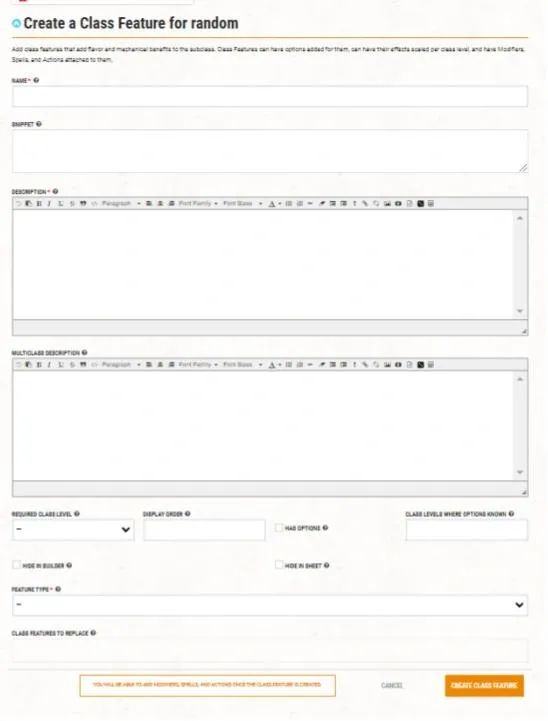
Creating Subclass Level Features
Creating a subclass feature requires selecting a class level between 1 and 20. Since the class is chosen in the initial subclass window, it already follows preset rules for when subclass features are granted. For example, rogues gain their subclass at level 3, while druids gain theirs at level 2. This makes the option to select features between levels 1 and 20 feel unnecessary.
After selecting the level, you must design the feature’s options and scaling. This process becomes increasingly complex, especially for subclasses with multiple selectable options, such as the Battle Master fighter’s maneuvers.
The most difficult part is that each feature must be built individually, repeating much of the same setup every time. As more features are added, the process becomes increasingly time-consuming and difficult to manage..
Fixing the DNDbeyond Homebrew System
After using the system extensively, it feels overwhelming. There is too much information presented at once—class level selection, spellcasting toggles, and multiple configuration fields. It appears the developers attempted to create a one-size-fits-all solution. However, this approach creates unnecessary complexity.
Below are two potential improvements.
Step-By-Step Homebrew Building
When creating a homebrew subclass, planning abilities by level is essential. The system could mirror the existing D&D Beyond character creator by guiding users through a structured, step-by-step process.
First, determine the magical abilities. If the base class is already a spellcaster, provide options to add additional spells, similar to subclasses like the Clockwork Soul sorcerer with predefined spell lists. If the base class does not normally cast spells, include clear options to introduce spellcasting and select a spellcasting modifier.
Next, present subclass features alongside a blank character sheet interface. Instead of manually configuring technical fields, allow users to interact directly with the sheet. If a feature grants +5 to initiative, the creator selects the initiative field and inputs the modifier.
Most subclass features modify ability scores, proficiency bonuses, or grant advantage or disadvantage. By allowing users to select and modify areas of the character sheet directly, the system becomes more intuitive.
If a feature includes selectable lists or scaling options, present them clearly and allow creators to add, remove, or modify entries. This keeps the focus on how the feature affects the character rather than on navigating backend configuration menus.
HASHTAGS Homebrew Building
For advanced users, an alternative approach would allow uploading a formatted document that uses hashtags to define mechanics. Many homebrew creators design subclasses on paper first, organizing features by level with descriptive names.
Players need clear tracking for elements like spell save DC, ability uses per level, or resource counts such as number of rages. A hashtag-based system could simplify this.
For example, creators could use tags like:
These could be combined with simple formulas, similar to Excel-style calculations:
=2*#Proficiency + #Nature
This approach focuses on clearly defining what changes for the character rather than navigating multiple configuration windows.
Example: Survivalist with Hashtags
When you choose this archetype at 3rd level, you gain proficiency in the Nature and Survival skills if you don’t already have it. Your proficiency bonus is doubled for any ability check you make that uses either of those proficiencies (=2*#proficiency + #nature) (=2*#proficiency + #survival).
The hashtag system makes the change explicit: the feature grants expertise in Nature and Survival. It clearly communicates what is being modified and simplifies integration into D&D Beyond.
Final Remarks
DNDBeyond is an excellent platform that simplifies character creation through a structured, step-by-step system. However, its homebrew tools—particularly subclass creation—are difficult to use and overly complex.
The two proposed improvements—a guided step-by-step builder and a hashtag-based advanced system—could make homebrew creation more interactive and intuitive.
I hope DNDBeyond considers improving the system. Whether or not they adopt these specific ideas, refining the homebrew tools would greatly benefit creators and Dungeon Masters alike.


Comments