


How to Make Dungeons and Dragons Boss Fights Better | DND Dungeon Master Guide
- 1 day ago
- 6 min read
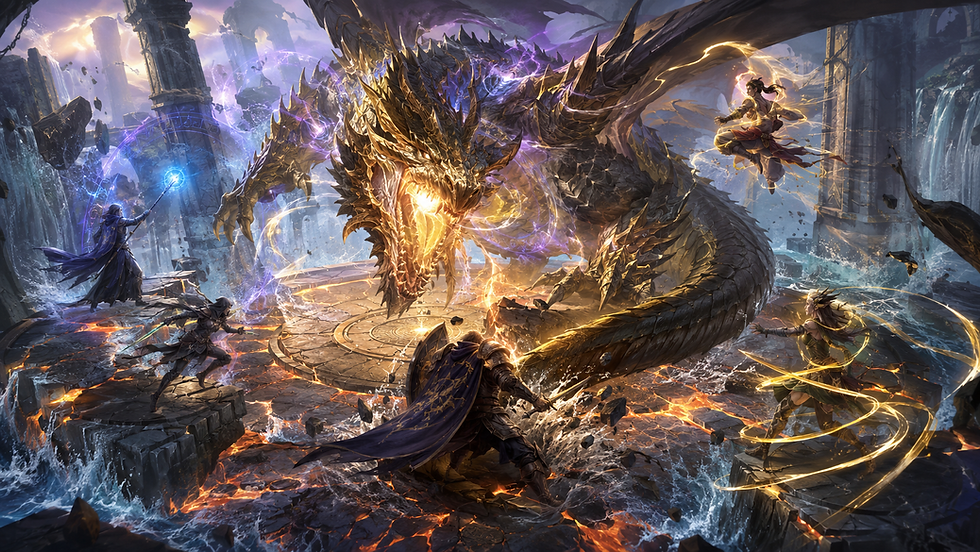
Dungeons and Dragons boss fights should feel terrifying—not turn into five rounds of everyone standing still and attacking until the boss dies.
As a DND Dungeon Master, I learned this after throwing a dragon at a Rogue, Monk, and Ranger and watching one of its biggest attacks barely matter. The fight was easier and far less exciting than I expected.
So I started changing how I build boss encounters in my Dungeons and Dragons games.
Instead of simply giving monsters more HP or damage, I use stronger Legendary Actions, changing battlefields, new abilities, and multiple boss phases that force players to adapt.
This guide will show Dungeon Masters how to create better DND boss fights using ideas for Dodgers, Frontliners, and Casters.
The goal is simple:
Make the boss memorable, not just harder to kill.
DND Boss Legendary Actions: Spell-Based Abilities
Spell-based Legendary Actions are an easy way to make Dungeons and Dragons boss fights more interesting without simply giving the monster another claw, bite, or weapon attack.
Use low-level spells that scale well, target different defenses, and force players to react.
Note: These examples use the 2024 / 5.5e versions of spells where applicable.
Dodgers
Dodgers are Rogues, Monks, and similar characters that are extremely good at avoiding Dexterity-save damage.
Let those abilities work—but make sure Dexterity is not the only save your DND boss can target.
Spell | Save / Attack | Damage Type | Higher-Level Scaling | Why Use It |
Arms of Hadar | STR Save | Necrotic | +1d6 per spell level | Targets Strength and hits nearby creatures |
Command | WIS Save | None | +1 target per spell level | Forces movement or disrupts turns |
Dissonant Whispers | WIS Save | Psychic | +1d6 per spell level | Damage plus forced movement |
Ray of Sickness | Spell Attack | Poison | +1d8 per spell level | Can inflict Poisoned |
Thunderwave | CON Save | Thunder | +1d8 per spell level | Damage plus 10-foot push |
Shatter | CON Save | Thunder | +1d8 per spell level | Strong non-DEX area damage |
Inflict Wounds | CON Save | Necrotic | +1d10 per spell level | Heavy close-range damage |
Boss Tip: Mix Dexterity attacks with STR, CON, and WIS saves so one defensive ability does not solve the entire fight.
Frontliners
Frontliners are Fighters, Barbarians, Paladins, and other characters designed to stay directly beside the boss.
High AC can make normal attack rolls unreliable, so use spells that force saves, move characters, or break positioning.
Spell | Save / Attack | Damage Type | Higher-Level Scaling | Why Use It |
Command | WIS Save | None | +1 target per spell level | Forces the frontliner to move or lose positioning |
Dissonant Whispers | WIS Save | Psychic | +1d6 per spell level | Forces the target away from the boss |
Thunderwave | CON Save | Thunder | +1d8 per spell level | Pushes nearby melee characters back |
Shatter | CON Save | Thunder | +1d8 per spell level | Punishes characters grouped around the boss |
Inflict Wounds | CON Save | Necrotic | +1d10 per spell level | Bypasses high AC completely |
Boss Tip: Movement can be more valuable than damage. Push the frontline away and force them to regain their position.
Casters
Casters are often glass cannons with strong defensive spells like Shield and Counterspell.
Use Legendary Actions to pressure those defenses and make them spend resources.
Spell | Save / Attack | Damage Type | Higher-Level Scaling | Why Use It |
Fireball | DEX Save | Fire | +1d6 per spell level | High area damage |
Melf's Acid Arrow | Spell Attack | Acid | +1d4 initial and +1d4 ongoing per spell level | Pressures AC and defensive spells |
Arms of Hadar | STR Save | Necrotic | +1d6 per spell level | Strength is often weak for casters |
Lightning Bolt | DEX Save | Lightning | +1d6 per spell level | High damage and punishes positioning |
Boss Tip: Make casters decide whether a Legendary Action is worth spending Shield, Counterspell, or another limited spell slot.
DND Boss Legendary Actions: Generic
Here are a few generic abilities you can modify to fit almost any monster.
For damage, adjust based on party HP and the number of Legendary Actions. A good target is for the boss's total Legendary Actions in a round to threaten around 25% of a character's HP.
Push — Move melee characters away so the boss stays mobile. Example: Tail Sweep — DEX save or pushed 15 feet and takes Xd6 Bludgeoning damage.
Restrain — Temporarily lock down a dangerous player. Keep it to about one turn. Example: Golden Lasso — STR save or Restrained until the end of their next turn and takes Xd6 Force or Radiant damage.
Teleport — Give the boss an easy way to move around the battlefield. Example: Into the Green — Teleport up to 60 feet, but the boss must appear within 5 feet of a tree or bush.
The mechanics can stay simple.
Just change the flavor to fit your monster.
A dragon uses its tail.
A celestial uses golden chains.
A plant monster disappears into the trees.
DND Boss Fight Phases and Stages
Legendary Actions help, but DND boss fights can still become repetitive if everyone just stands there and attacks.
Use boss phases to change the battlefield, force movement, or completely change how the boss fights.
1. Damage Absorption
Players often unload their strongest abilities immediately.
Give the boss something else that takes the damage first.
Examples:
A dragon mount takes the damage instead.
A magical idol absorbs the damage.
A shield crystal protects the boss until destroyed.
The absorber explodes when destroyed and changes the battlefield.
DM Tip: Make it obvious that something strange is happening.
"The Fireball explodes, but the boss looks completely unharmed."
"You notice the dragon looks much more injured than the boss."
Players should be able to figure out the mechanic.
2. Terrain Modification
Most players find a good position and stay there.
Don't let them.
Examples:
Lava erupts from the ground.
Sections of the arena collapse.
Acid pools appear.
Walls divide the party.
Water floods part of the battlefield.
Different terrain sections move each round.
One mechanic I love is dividing the battlefield into four areas:
Forest. Lake. Acid Pool. Open Ground.
Then those areas randomly move or change throughout the fight.
You can also connect the terrain directly to the boss.
Example Boss Mechanic: Creatures standing in flooded sections take additional damage from the Blue Dragon's Lightning Breath.
Now the players have to think about where they are standing, not just what attack they use next.
3. Transformation
Change the boss when it reaches a certain HP threshold.
Examples:
At 50% HP, the boss transforms.
A spellcaster becomes a powerful melee fighter.
The boss gains new Legendary Actions.
Its resistances or vulnerabilities change.
Its movement changes.
Its attacks completely change.
One of my favorite DND boss mechanics is changing what the boss is good at.
The first half of the fight might be against a caster with powerful spells and weak physical defenses.
At 50% HP, the boss transforms into a powerful melee fighter with high Strength and completely different defenses.
Now the strategy the players used during Phase One might not work anymore.
They have to adapt.
4. Charge-Up Phase
Give the players one round to recognize and react to something extremely dangerous.
Example:
At 50% HP, the boss curls into a ball and begins charging energy.
For one round, it gains heavy resistance or immunity.
At the end of the next round, any creature not behind cover is dropped to 0 HP.
Now the players have a choice:
Keep attacking or RUN FOR COVER.
The important part is giving them enough warning to understand what is happening.
If the players die because they ignored the warning, that's one thing.
If they die because there was no warning, that's just frustrating.
DND Boss Fight FAQ
How do you make a Dungeons and Dragons boss fight better?
Give the boss ways to move, change the battlefield, use Legendary Actions, and enter new phases instead of simply increasing its HP.
What are good Legendary Actions for a DND boss?
Pushes, teleportation, restraints, forced movement, saving-throw spells, and battlefield-changing abilities are all great DND Legendary Action options.
How many phases should a DND boss have?
Most Dungeons and Dragons boss fights only need two or three distinct phases. Each phase should change how the players approach the encounter.
How do you stop a DND boss from getting surrounded?
Give the boss pushes, teleportation, terrain effects, forced movement, or abilities that punish players for staying in one location.
Should a DND boss counter the players?
Not completely.
Let the Rogue dodge attacks.
Let the Fighter's armor stop attacks.
Let the Wizard use Shield.
Then challenge them somewhere else.
Final Thoughts
A memorable Dungeons and Dragons boss fight isn't about giving the monster more HP.
Make the players move, react, change strategies, and use abilities they normally ignore.
Give your boss Legendary Actions.
Change the battlefield.
Add phases.
Force the party to adapt.
Most importantly, let your players feel powerful while still making them wonder:
“What the hell is this boss going to do next?”


Comments