


Arsonist Rogue — D&D 5e Homebrew Subclass
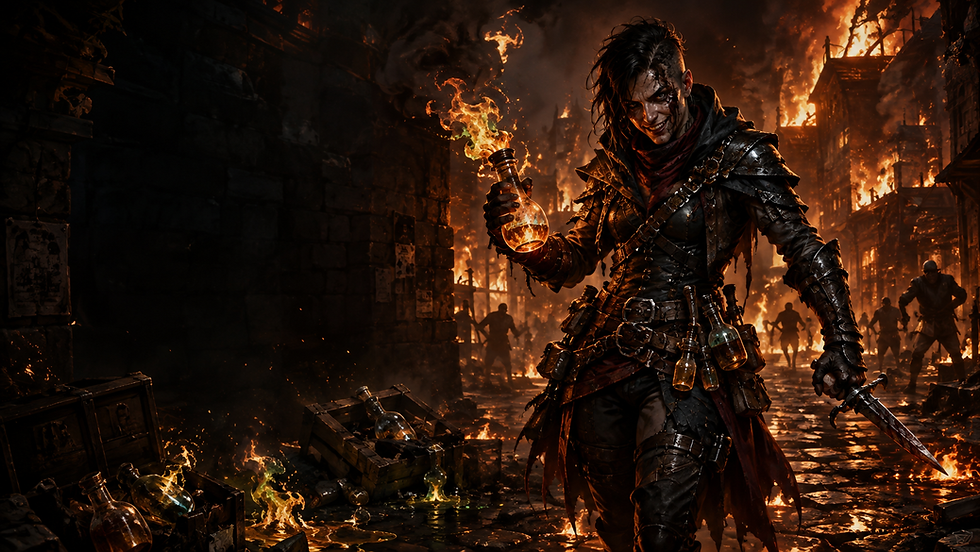
Most Rogues in Dungeons & Dragons hide the evidence. The Arsonist has a different solution: burn it. Inspired by dangerous criminals, fire investigators, and the chaotic environmental destruction you can create in games like Baldur’s Gate 3, the Arsonist turns fire into a weapon, distraction, escape plan, and calling card.
What Is the Arsonist Rogue?
The Arsonist is a homebrew D&D 5e Rogue subclass focused on alchemist’s fire, burning damage, and increasingly destructive fire abilities. Instead of relying only on Sneak Attack to quickly eliminate a target, the Arsonist can set enemies ablaze and force them to decide whether to keep fighting or spend precious time extinguishing the flames.
As the Arsonist grows stronger, their fire becomes harder to resist. They eventually learn to burn creatures that would normally resist or even ignore fire damage, before reaching a point where a single target is no longer enough and entire sections of the battlefield can become their masterpiece.
The Arsonist at a Glance
Class: Rogue
Primary Ability: Dexterity
Combat Role: Damage / Battlefield Pressure
Playstyle: Hit, ignite, move, and let burning damage continue working
Complexity: Moderate
Theme: Arson, alchemical fire, and controlled destruction
Signature Mechanic: Enhanced alchemist’s fire and persistent burning damage
What Can the Arsonist Do?
Level 3 — Alchemical Arson
The Arsonist begins creating their own unstable flasks of alchemist’s fire after each long rest, giving them a renewable supply of their signature weapon without allowing those flasks to be stockpiled indefinitely.
Their homemade alchemist’s fire is also stronger than the normal version, establishing fire as a genuine part of the Rogue’s combat strategy rather than simply an occasional item they throw at an enemy.
Level 9 — Burning Strike
Burning Strike lets the Arsonist work alchemist’s fire directly into their Sneak Attack. By sacrificing part of their Sneak Attack damage and expending one of their flasks, they can guarantee that the target catches fire.
This changes the Arsonist’s action economy considerably. Instead of choosing between making a normal attack and throwing alchemist’s fire, they can combine the two and force an enemy to either continue taking burning damage or spend an action putting out the flames.
The Arsonist also gains resistance to fire damage at this level, representing how accustomed they have become to working around dangerous heat and flame.
Level 13 — Unrelenting Flame
By 13th level, ordinary fire is no longer enough. Unrelenting Flame allows the Arsonist’s fire damage to ignore fire resistance.
Even creatures normally immune to fire are no longer completely safe. Their immunity instead reduces the Arsonist’s fire damage rather than preventing it entirely.
This feature is especially important because fire resistance and immunity become more common among the powerful monsters encountered at higher levels.
Level 17 — Masterpiece of Flame
The Arsonist’s obsession with fire finally grows beyond burning individual enemies.
Once per long rest, the Arsonist can unleash either delayed blast fireball or fire storm, giving the subclass the ability to affect enormous areas and groups of enemies.
At this point, the Arsonist is no longer simply setting someone on fire and disappearing into the smoke. They can turn entire sections of a high-level battlefield into their masterpiece.
How to Play the Arsonist Rogue
Combat
The Arsonist works best as a mobile Rogue who strikes an important enemy, sets them burning, and then keeps moving.
Burning Strike is especially important to this style. Instead of relying entirely on a large burst of Sneak Attack damage, the Arsonist can sacrifice some immediate damage in exchange for damage that continues on later turns. The enemy then has a choice: keep attacking while burning or spend an action extinguishing the flames.
That action cost is one of the most interesting parts of the subclass. Against an important enemy, forcing them to spend an action dealing with the fire can sometimes be nearly as valuable as the damage itself.
The Arsonist should therefore look for dangerous enemies that will suffer from losing an action and spread burning pressure around the battlefield whenever possible.
Exploration
The Arsonist subclass does not significantly improve the Rogue’s normal exploration abilities.
A Rogue can already be excellent at scouting, Stealth, searching, investigating, and dealing with traps depending on their skills and Expertise choices. The Arsonist does not directly improve those areas, so most of their exploration ability still comes from the base Rogue class.
Social Interactions
The Arsonist does not provide mechanical bonuses to Persuasion, Deception, Intimidation, or other social abilities.
Players can certainly build an Arsonist with a strong personality or lean into the intimidating reputation of someone obsessed with fire, but those are roleplaying choices rather than subclass mechanics.
Environmental Interactions
Fire resistance gives the Arsonist one useful advantage when dealing with environments that cause fire damage.
This can help when encountering burning buildings, fire-based traps, areas filled with flame, or other hazards that deal fire damage. It does not protect the character against unrelated environmental dangers such as acid, poison, or other hazards.
Building an Arsonist Rogue
Best Ability Scores
Dexterity should be the Arsonist’s highest ability score.
The subclass is still a Rogue and therefore already relies heavily on Dexterity for weapon attacks, Armor Class, initiative, Stealth, and many important Rogue skills. Dexterity becomes even more valuable for the Arsonist because their high-level fire abilities also use Dexterity.
After Dexterity, the subclass does not require a specific secondary ability score. Constitution is always useful for additional hit points, but Intelligence, Wisdom, and Charisma are not required by the subclass’s core mechanics.
Best Feats
Tough — Additional hit points can help the Arsonist survive increasingly dangerous encounters, particularly at higher levels when enemy damage becomes much greater.
Sentinel — Sentinel can give the Rogue additional opportunities to punish enemy movement or enemies attacking nearby allies, making it useful for an Arsonist who wants more opportunities to make weapon attacks.
Resilient — Improving an important saving throw can become increasingly valuable as higher-level monsters and spellcasters begin using more dangerous effects.
Best Multiclass Options
Fighter — Fighter is probably the strongest multiclass option from the ideas considered for this subclass. It provides useful martial abilities, a Fighting Style, and Action Surge without forcing the character away from Dexterity.
Monk — Monk can work when the character’s weapon choices and ability scores support the combination, though it requires more consideration than Fighter.
Barbarian — Barbarian is harder to recommend mechanically because Rage generally favors Strength-based attacks while the Arsonist heavily favors Dexterity. It can still work for a player who cares more about creating a reckless, fire-loving character than maximizing mechanical efficiency.
Full spellcasting classes such as Wizard, Sorcerer, Warlock, or Cleric are less appealing for the intended Arsonist concept because they can pull the character away from the straightforward Rogue-and-fire identity of the subclass.
Why I Created the Arsonist Rogue
When I think about Rogues in Dungeons & Dragons, I usually picture characters who exist somewhere outside the law: thieves, assassins, spies, con artists, and criminals who always seem one bad decision away from getting arrested. That made me think about another kind of criminal that could fit the Rogue extremely well: an arsonist.
Shows like Psych, The Mentalist, and even episodes of American Dad featuring unusual criminals and investigators helped push the concept further. Games like Baldur’s Gate 3 also demonstrate how entertaining fire can become when it changes the battlefield—barrels explode, surfaces ignite, buildings burn, and one spark can completely change an encounter. I wanted to take that feeling and create a Rogue whose entire identity revolves around fire.
The result is intentionally straightforward. The Arsonist likes fire. They create alchemist’s fire, set enemies ablaze, learn how to overcome creatures that resist their favorite damage type, and eventually become capable of creating enormous displays of destruction.
Dungeon Master Notes
The most important mechanic for a Dungeon Master to watch is persistent burning damage.
Even a relatively small amount of repeated fire damage can become significant if an enemy remains burning for several rounds. More importantly, putting out the flames costs the creature an action. That creates a tactical decision: continue fighting and take more damage, or spend an action extinguishing the fire.
Fire resistance and immunity are another important consideration. The Arsonist is heavily specialized around fire damage, which means certain creatures could normally shut down much of the subclass. Unrelenting Flame eventually prevents that problem by allowing the Arsonist to ignore resistance and deal reduced damage even to creatures normally immune to fire.
At high levels, Masterpiece of Flame also changes the scale of the subclass considerably by giving the Rogue access to delayed blast fireball or fire storm once per long rest. The Arsonist goes from applying pressure to individual enemies to potentially affecting a much larger battlefield.
Ready to Bring the Arsonist to Your Table?
The downloadable Arsonist Rogue PDF will contain the complete subclass rules, including:
Full subclass progression
Alchemical Arson
Burning Strike
Unrelenting Flame
Masterpiece of Flame
Complete mechanical wording
Resource limitations
Burning rules
Everything needed to play the subclass
The Arsonist Rogue is free to download and use at your D&D table.
If you enjoy my homebrew and want to help me continue creating new D&D classes, subclasses, monsters, encounters, and other resources, you can optionally support my work.
You never have to donate to use my homebrew.


Comments