


Why I Created a Pokémon Trainer D&D Class
Updated: Aug 7

What would happen if a Dungeons & Dragons character could capture monsters, build a team, evolve companions, and choose the right creature for every challenge?
That question inspired my Pokémon Trainer D&D class.
Pokémon and Dungeons & Dragons already share many ideas. Both focus on exploration, dangerous creatures, teamwork, growth, and overcoming increasingly difficult challenges.
Instead of creating a character who personally gains stronger attacks or spells, this class grows by capturing, training, and evolving Pokémon.
Why It Needs to Be a Full Class
A Pokémon Trainer needs more than a single creature companion.
The class requires rules for capturing monsters, preparing an Active Team, storing additional Pokémon, evolving companions, switching between them during battle, and commanding their attacks, spells, and special abilities.
A Ranger subclass could provide one companion, while an Artificer subclass could explain how Poké Balls work. However, neither option has enough room to create the complete Trainer experience.
The Pokémon are not an extra feature added to the class.
They are the class.
How the Pokémon Trainer Stays Balanced

Official D&D classes gain their power directly. Fighters gain more attacks, Barbarians become harder to kill, Rogues improve Sneak Attack, Paladins gain stronger Smites, and spellcasters learn increasingly powerful magic.
The Pokémon Trainer does not personally receive those benefits.
The Trainer has a d8 Hit Die, limited weapon training, and no Extra Attack or full spellcasting. Capturing a stronger Pokémon does not improve the Trainer’s Armor Class, hit points, ability scores, or weapon damage.
This creates a major weakness: enemies can attack the Trainer instead of fighting the Pokémon.
The class’s strength is not personal power. It is flexibility.
The Active Team Provides Choices
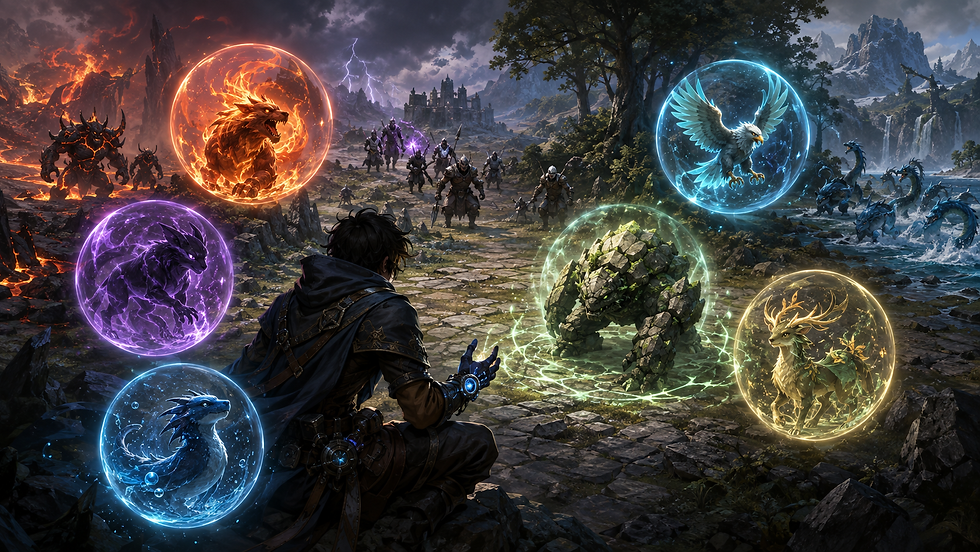
One Pokémon might protect the party, while another deals damage, scouts an area, tracks an enemy, crosses water, flies over an obstacle, or survives a dangerous environment.
Even at higher levels, the Trainer cannot command an entire Active Team at once. Only a limited number of Pokémon can be summoned, and their strongest attacks, spells, and abilities require the Trainer’s action.
The Active Team provides choices, not six complete turns.
Capturing Pokémon also gives the class a reason to explore the world differently. A Trainer may search for a creature with flight, fire resistance, unusual senses, a useful language, or an ability needed for an upcoming challenge.
A desired Pokémon can become a reward, a side quest, or the reason the party enters a dangerous location.
What Dungeon Masters Should Know

Dungeon Masters should review every Pokémon and evolution before approving it.
Monster stat blocks were designed as enemies, and some abilities can become disruptive when placed under permanent player control. This is especially true for creatures that summon allies, possess others, create treasure, restore the dead, duplicate themselves, or permanently control creatures.
The class includes Universal Pokémon Restrictions to prevent many of these problems. The Dungeon Master still has final authority over which creatures, evolutions, spells, and abilities are appropriate.
Permission to play this class does not guarantee permission to capture every creature. A Dungeon Master may prohibit a unique, legendary, summoned, narratively important, or mechanically disruptive monster.
These expectations should be discussed before the campaign begins.
The Goal of the Class
The goal of this D&D homebrew class is not to overshadow the official Dungeons & Dragons classes.
The goal is to recreate the experience of being a Pokémon Trainer: exploring the world, capturing unusual creatures, building a varied Active Team, forming bonds with companions, and choosing the right Pokémon for every challenge.
The strongest Trainer is not always the one with the highest-CR monster.
The strongest Trainer is the one who understands their team.
Continue Reading
The next page contains the complete Pokémon Trainer class, including its capture rules, Active Team, Pokémon Pool, Evolution system, and features from levels 1 through 20.
You can also read the character-building guide for recommended ability scores, feats, multiclass options, backstories, and gameplay advice.


Comments